
Woodward Skills provide a comprehensive toolkit for developing leadership, interpersonal, and problem-solving capabilities. They are based on a framework created by Development Dimensions International (DDI) to help individuals and teams thrive.
Woodward Skills provide a comprehensive toolkit for developing leadership, interpersonal, and problem-solving capabilities. They are based on a framework created by Development Dimensions International (DDI) to help individuals and teams thrive.

Step1: Identify Your Focus
- Choose a skill: Out of the skills provided, choose one skill that you would like to develop.
- Decide on a time commitment: Determine how much time you can realistically dedicate to the
development of this skill.

Step2: Select your Learning Path
- Pick a Microcourse or Learning Challenge: Choose a structured learning resource for your skill.
Microcourses or challenges are ideal because they are concise and manageable. - For example, select a course that requires as little as 15 minutes total or up to 30 minutes a
week for 6 weeks.

Step3: Plan for Application
- Pick a Microcourse or Learning Challenge: Choose a structured learning resource for your skill.
Microcourses or challenges are ideal because they are concise and manageable. - For example, select a course that requires as little as 15 minutes total or up to 30 minutes a
week for 6 weeks.

Step4: Select your Learning Path
- Engage your peer: Share your learning with your co-workers.
Microcourses or challenges are ideal because they are concise and manageable. - Collaborate with others: Find other members who share the same interest and set up regular
meetings to exchange ideas, discuss challenges and expand your knowledge together.
By following these steps, you can effectively build a habit of learning that will benefit you both
personally and professionally. Whether you’re gaining new skills for your current role or simply
pursuing personal growth, a consistent learning habit empowers you to thrive in an ever-changing
world.
A deep dive into professional competencies is an in-depth study into a specific subject matter that goes beyond surface level understanding. Continuous learning opportunities allow for the expansion of knowledge throughout the professional development process. Learn more about when and why to consider a Deep Dive.

Why should you consider diving deeper into core competencies to help develop your professional and leadership skills?
The purposeful development of interpersonal skills is what often accelerates promotion. Communication, adaptability, and conflict resolution are some of the many skills needed to develop an emotionally intelligent workforce. For instance, strong communicators are 2.5 times more
likely to be viewed as leadership-ready than those lacking strong communication skills. (Harvard Business Review, 2022)
Continuous Learning allows members the opportunity to hone skills that prepares them for Leadership roles and this allows organizations to reassign or promote from within (Rumage, Built In, 2024). Developing an emotionally strong workforce also aids team performance, growth, and retention.
An organization’s ability to compete in today’s global market is heavily relied upon by the strength of its human capabilities (Cook, et.al, 2020). Investment in members’ continuous learning allows for the enterprise to maintain a competitive edge.
What’s In It For You?
- 1. Confidence and Morale Booster
- 2. Visibility as a Leader
- 3. Stronger Decision Making
How to Start:
- Choose a competency that interests you from the Woodward YOU competency list and complete the course. Deep Dive courses are typically 30 minutes or longer.
- After finishing the course, reflect on the experiences in which you were confronted with this competency. The following questions can help guide this reflection:
- How has this competency been role modeled for me throughout my career (Both positively and negatively)?
- What is one habit I can incorporate this week to improve my ability to perform in this competency?
- How can strengthening my proficiency in this competency help me be a better team member and/or leader?
- Set up a time to speak with your leader about what you have learned from this course and how you can continue to apply this information to your role. Also consider asking for feed back on how you perform in this skill and what you can do to improve.
- Find other members who are interested in this topic to continue to conversation in a shared environment.
- Now you’re ready to JUMP IN!
Remember a time when you learned something interesting and immediately told someone else about it?
That’s social learning. Learn more about how to activate social learning in your work environment.
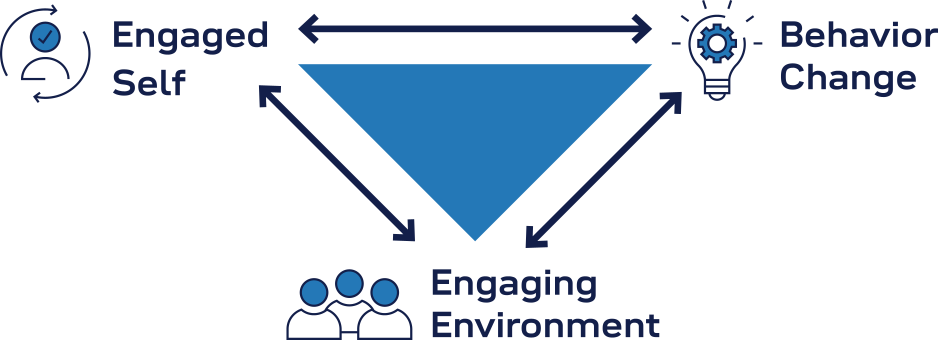
Benefits
- Learning becomes sustainable and doesn’t stop in the classroom
- You manage when & where learning takes place
- Ability to learn enterprise-wide skills
How to Socially Learn
- Daily team micro learning
- Start a book club
- Share your learning experience with peers & leaders
- Observe others in action & reproduce the behavior
- Try, learn, discuss

Why should you consider diving deeper into core competencies to help develop your professional and leadership skills?
Social learning may sound like some new training and learning method, however it’s more than likely you’ve been active in social learning most of your life. Canadian psychologist Albert Bandura, has done extensive research on social learning and enhanced the understanding that we learn and do, first by observing others’ actions.
The following information is provided to give you a brief overview of how to activate social learning in your work environment.
What’s In It For You?
- You are more engaged in your learning and personal development
- Your behaviors reflect that of what you learned, especially when you’ve seen someone else demonstrate the behavior
- You build a more engaging environment and work culture by driving interaction and learning with others
What are some ways to socially learn?
- Start a book club – Select a book for development, hold regular meetings, discuss what each of you learned.
- Daily micro-learning – As a team, have moments for each other to share and train others. It allows a moment of learning for all and helps highlight areas that members are passionate about that may have been missed.
- Try, Learn, Discuss – A key aspect of social learning is observation, retention, and reproduction. When you learn something it’s not only important to put it into practice but tell someone else about it to reinforce your knowledge and potentially expand their knowledge base as well.